With the rapid iteration and frequent upgrading of electronic products, e-waste has evolved into a huge category of global waste materials. Statistics show that the annual global output of waste printed circuit boards (PCBs) exceeds 50 million tons. As the core carrier of electronic equipment, waste PCBs are rich in valuable resources, consisting of approximately 30% metallic copper, 1% precious metals such as gold, silver and palladium, and 60% non-metallic materials including resin and glass fiber, earning them the reputation of a veritable “urban mine”.
In the past, waste circuit boards were mostly disposed of through landfilling and incineration. Such traditional methods not only lead to the massive loss of valuable metal resources and severe waste of scarce mineral resources, but also trigger serious ecological pollution. Incineration releases highly carcinogenic toxic substances such as dioxins and polychlorinated biphenyls, while landfilling causes heavy metals including lead and copper to seep into soil and groundwater, continuously damaging the ecological environment and endangering human health. For a long time, the harmless disposal and resource utilization of e-waste has remained a major industrial challenge.
With the innovation and upgrading of renewable resource technology, professional physical mechanical recycling equipment has realized the efficient and precise separation of metals and non-metals from waste circuit boards, unlocking the regeneration value of waste materials and achieving the green transformation of “turning waste into treasure”. The waste circuit board crushing and recycling production line features strong adaptability. It can precisely separate metal and non-metal components from various materials, including waste circuit boards, copper-clad laminates, and leftover materials from circuit board production, serving as the core supporting equipment for e-waste resource recycling.
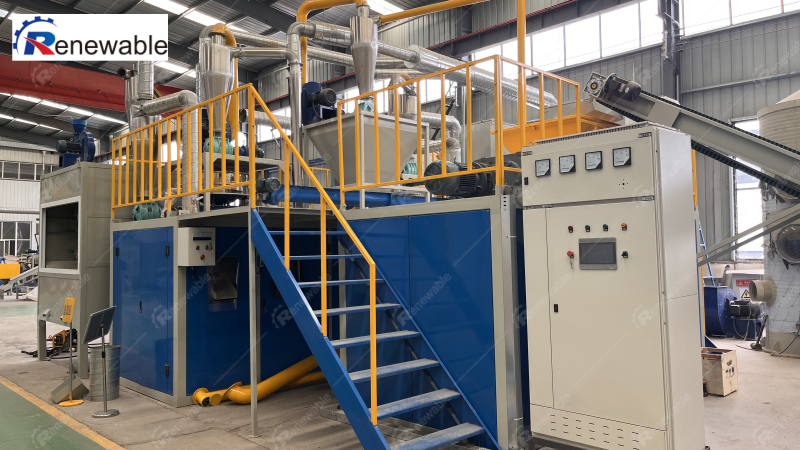
The entire recycling process adopts a mature process ofthree-stage gradient crushing and dual sorting to achieve refined material treatment step by step. The first-stage crushing adopts a double-shaft tearing structure for coarse crushing of large waste circuit boards to disassemble the overall material structure. The second-stage crushing uses a hammer mill for medium crushing of coarsely crushed materials to refine particle size. The third-stage crushing applies a high-speed turbo grinder for ultra-fine pulverization, processing materials into uniform fine powder and completely breaking the bonding structure between copper, precious metals, resin and glass fiber.
The crushed mixed powder undergoes dual refined sorting via air classification and electrostatic sorting equipment. Relying on the differences in specific gravity and electrical conductivity of different materials, the system accurately separates mixed metal powder and pure resin powder. The entire process requires no chemical agents, fundamentally avoiding secondary pollution. It not only thoroughly solves the environmental disposal problem of e-waste, but also maximizes the recovery of valuable metal resources and restores the industrial utilization value of waste materials.
Compared with traditional processes, the core physical crushing and electrostatic sorting technology boasts prominent advantages. Adopting a full dry treatment mode, it produces no waste water, waste gas or waste residue, achieving nearly zero pollution and zero residue with both high efficiency and environmental friendliness. This green technology has not only broken through the technical bottlenecks in the resource utilization of waste circuit boards, but also continuously reshaped the global renewable resource supply chain system.
Technology empowers solid waste regeneration, and innovation drives green development. The refined recycling and separation technology for waste circuit boards effectively addresses the ecological and environmental problems caused by e-waste and realizes the recycling of mineral resources. It also provides solid technical support for the construction of zero-waste cities and the implementation of carbon peaking and carbon neutrality goals, enabling every waste electronic material to regain vitality and fuel the future of green and sustainable development.